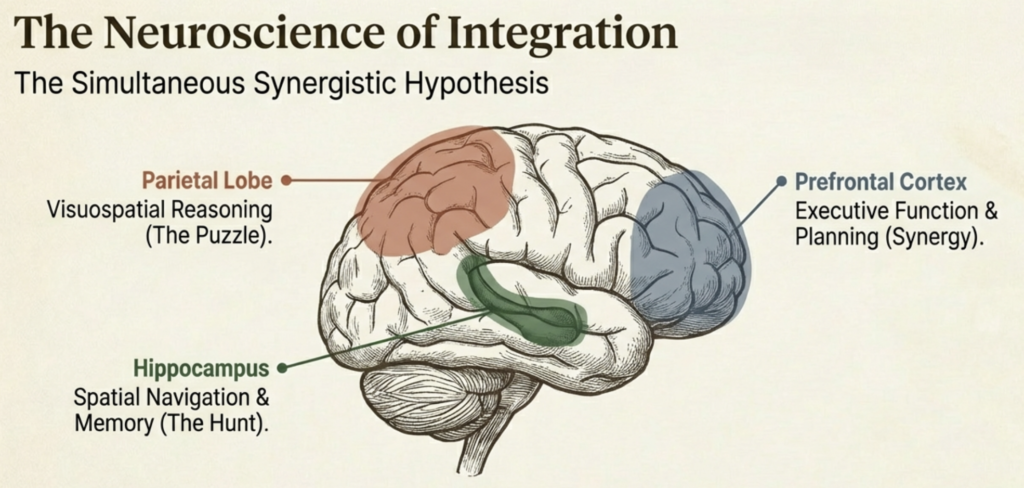
Based on the provided sources, the comparison between analog puzzles and digital brain apps for memory centers on a distinction between specific skill training (digital) and holistic cognitive maintenance (analog).
While digital apps offer targeted algorithmic training, they suffer from a ”credibility gap” regarding real-world application. In contrast, analog puzzles are viewed as broad ”protective factors” that engage working memory and reduce stress simultaneously.
1. Digital Brain Apps: The ”Transfer” Problem
Digital brain training is a rapidly growing market, yet the scientific consensus on its ability to improve memory in daily life is mixed.
- The Transfer Gap: The primary criticism of consumer brain apps is that they successfully train users to get better at the specific game (”near-transfer”), but this rarely translates to improved memory in real-world tasks (”far-transfer”).
- Memory vs. Speed: In the landmark ACTIVE trial (the largest study of its kind), specific memory training did not demonstrate a statistically significant effect on reducing dementia risk. However, a different digital intervention—Speed of Processing Training (visual attention)—was clinically proven to reduce dementia risk by 29% to 48%.
- Regulatory Scrutiny: Many apps face a ”credibility gap” where marketing claims outpace evidence. New EU regulations (MDR) are now reclassifying many of these apps as medical devices, requiring them to prove clinical efficacy rather than just ”wellness” benefits,.
2. Analog Puzzles: Holistic Working Memory
Analog puzzles, particularly jigsaw puzzles, are supported by observational research as a tool for maintaining cognitive health and building ”cognitive reserve” (resilience against decline).
- Bilateral Integration: Jigsaw puzzles engage both the left hemisphere (logic/linear thinking) and the right hemisphere (creativity/intuition). This bilateral integration strengthens neural connections,.
- Working Memory Workout: Puzzles provide a rigorous workout for working memory and short-term memory. The brain must simultaneously hold the visual image of the ”whole” picture while manipulating individual ”parts,” remembering shapes, colors, and strategies (e.g., sorting by edge),.
- Protective Factor: Research indicates that adults over 50 who regularly engage in puzzles perform better on global cognitive tests. It is identified as a potential protective factor against cognitive aging.
3. The Stress Factor: ”Technostress” vs. The ”Alpha State”
A critical differentiator is the physiological state induced by the activity.
- Analog ”Alpha State”: Analog puzzles induce a state of relaxation similar to meditation, known as the Alpha state. This reduces cortisol (stress hormone) levels. Since chronic stress is detrimental to memory and brain health, the stress-reducing nature of analog puzzles acts as a secondary cognitive benefit,.
- Digital Fatigue: Digital apps operate within the ”attention economy,” which can contribute to ”technostress” and hyper-vigilance. The blue light and constant connectivity associated with screens can disrupt sleep and fragment attention, potentially counteracting some cognitive gains,,.
Summary Comparison
| Feature | Analog Puzzles (e.g., Jigsaws) | Digital Brain Apps |
|---|---|---|
| Primary Memory Benefit | Working Memory: Retaining shapes/colors while visualizing the whole image. | Task-Specific: High improvement in the specific game played, but low transfer to daily life. |
| Clinical Evidence | Protective: Observational data links it to delayed cognitive decline and better global test scores. | Mixed: Speed of Processing is clinically validated to reduce dementia risk; Memory training is generally not. |
| Physiological Impact | Relaxation: Induces ”Alpha state” and reduces cortisol (stress). | Technostress: Can contribute to digital fatigue and eye strain. |
| Brain Activation | Bilateral: Engages both hemispheres and fine motor cortex,. | Targeted: Engages specific neural circuits based on the algorithm. |