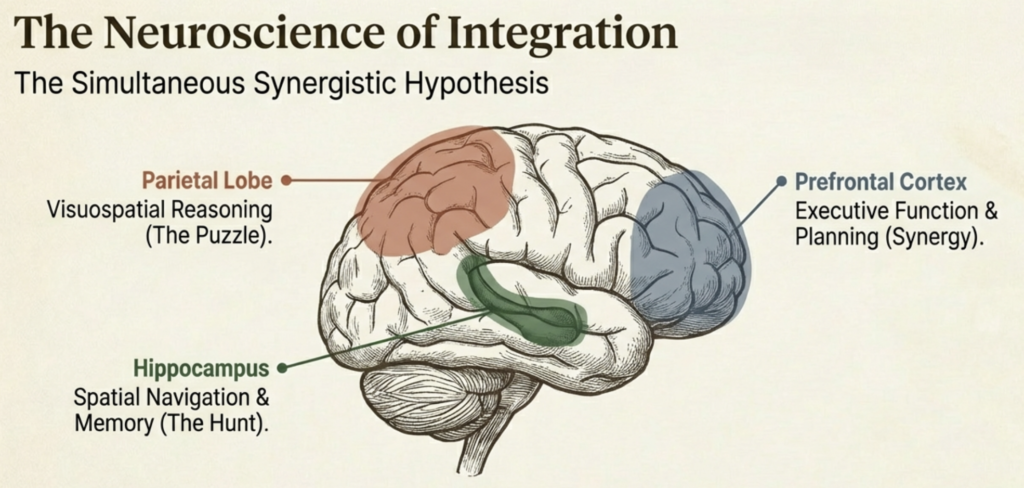
Based on the provided sources and our conversation history, the shift from passive consumption (e.g., scrolling social media, binge-watching) to active creation (e.g., solving puzzles, painting, writing) triggers a fundamental change in the brain’s neurobiology.
This is not merely a psychological shift in mood; it is a measurable biological transition involving different brain networks, neurochemicals, and electrical frequencies.
1. Neural Network Dynamics: The ”Triple Network” Handshake
The most significant difference lies in how the brain’s major networks interact.
- During Consumption (The ”Receptive” State):
- Passive & Fragmented: Consumption often engages the Default Mode Network (DMN) in isolation (associated with mind-wandering) or triggers the Executive Control Network (ECN) only reactively.
- The ”Energy Conservation” Mode: The brain enters a mode of low metabolic demand. It does not need to synthesize new information, leading to ”synaptic pruning” (the removal of connections) due to a lack of challenge.
- Fragmentation: Digital consumption, specifically, creates a ”fragmented” state where the brain rapidly switches focus, preventing deep engagement.
- During Creation (The ”Generative” State):
- The ”Handshake”: Creativity requires a unique, high-speed synchronization between usually opposing networks. The Salience Network (SN) acts as a switch, facilitating a ”handshake” between the DMN(imagination/idea generation) and the ECN (logic/editing).
- Transient Hypofrontality: In deep states of creation (Flow), the Prefrontal Cortex (the inner critic) temporarily down-regulates. This quiets self-consciousness and allows the specialized processing networks to function without interference.
- Bilateral Integration: Constructive tasks like jigsaw puzzles force bilateral integration, recruiting the left hemisphere (logic/sorting) and the right hemisphere (visual/intuitive) simultaneously. This strengthens the corpus callosum, the bridge between the two sides.
2. Neurochemistry: ”Cheap” vs. ”Deep” Fuel
The chemical environment of the brain changes drastically depending on the mode of engagement.
| Chemical | Consumption (Passive) | Creation (Active) |
|---|---|---|
| Dopamine | ”Cheap Dopamine”: Triggered by external stimuli (likes, notifications). It is fast, fleeting, and leads to craving without satisfaction. | ”Deep Dopamine”: Triggered by effort and self-efficacy (”I made this”). It is slow-building and sustained. |
| BDNF | Suppressed: Lack of novelty and effort leads to a decline in Brain-Derived Neurotrophic Factor (the brain’s ”fertilizer”). | Elevated: Active problem-solving increases BDNF by 20–30%, promoting the growth of new neurons and synapses. |
| Cortisol | Elevated: ”Technostress” and high-beta wave anxiety keep stress hormones high. | Suppressed: Creative focus induces an ”Alpha state,” acting as a biological barrier to stress and lowering cortisol. |
| Oxytocin | Low: Unless specifically interacting with loved ones, digital consumption rarely triggers bonding hormones. | High: Viewing personal photos or ”savoring” memories during creation (e.g., a photo puzzle) releases oxytocin, acting as a ”biological painkiller”. |
3. Brain Waves: The Shift in Frequency
The electrical rhythm of the brain shifts to match the task.
- Consumption (High-Beta / Low-Alpha):
- Passive consumption often traps the brain in High-Beta waves (associated with anxiety and hyper-alertness) or ”zoning out” without focus.
- This state is linked to ”cognitive thinning,” where the prefrontal cortex loses impulse control over time.
- Creation (Alpha-Theta + Gamma):
- The Flow Bridge: Creation creates a bridge between Alpha waves (relaxation) and Theta waves(introspection/dreaming), creating a state of ”alert relaxation”.
- The ”Aha!” Gamma Burst: When a creator solves a problem (e.g., finding the right puzzle piece), the brain fires Gamma waves (the fastest frequency). This burst physically ”sears” the information into long-term memory and upgrades the brain’s visual-spatial library.
4. Long-Term Structural Impact
Over time, these transient states lead to permanent structural changes in the brain.
- Cognitive Reserve (The ”Youth” Effect):
- Engaging in creation builds ”Cognitive Reserve”—a dense buffer of neural connections. Research suggests that regular ”creators” (including puzzlers) possess a functional ”brain age” 8 to 10 years younger than their chronological age.
- This reserve acts as a protective shield, delaying the onset of dementia symptoms by allowing the brain to reroute signals around damaged areas.
- The ”Tactile” Advantage:
- The ”Tactile Hypothesis” suggests that creating with physical objects (analog vs. digital) activates unique skin-brain pathways. This stimulation of Mrgprb4-lineage neurons (touch receptors) directly buffers the stress response, a benefit not found in digital creation.
Summary: The ”Active Inference” Engine
Ultimately, the brain changes because creation forces it to become an Inference Engine.
When you consume, the brain is a ”receptacle.” When you create—whether it is filling the ”gutter” in a comic book, mentally rotating a puzzle piece, or interpreting a ”lean” message on a postcard—the brain must generate information that isn’t there. This process, known as Active Inference, synchronizes distant brain regions and is the biological hallmark of maintaining a healthy, resilient mind.